Editorial note (consolidated edition). This document consolidates several overlapping
versions of a personal research archive (a core manuscript, an appendix of process transcripts, and
supporting captures) into a single coherent text. Redundant material has been removed and the strongest
explanation of each concept retained. The work is explicitly speculative: it is offered as a
well-formulated question, not as a validated physical theory. Following the author’s own method, the
manuscript maintains four visible epistemic layers —
rigorous,
empirical,
speculative, and
poetic — and never presents speculation as established fact.
Concept DOI: 10.5281/zenodo.20329781 · Consolidated edition v16 · CC BY 4.0
Contents
1. Executive Summary
This manuscript proposes a speculative cosmological framework in which the observable universe
(A) is globally coupled to a complementary mirror universe (B) through a
non-local, antisymmetric geometric interaction. Within this picture, the observed accelerated expansion
— conventionally attributed to the cosmological constant Λ — is reinterpreted as an
emergent geometric effect of the coupling rather than as a distinct substance with negative
pressure. The Friedmann equations are left structurally unmodified; Λ is read as a parameter
encoding membership in a larger symmetric structure.
The framework’s central analytical claim is algebraic: the antisymmetric A–B dynamics share
the formal structure of quaternionic non-commutativity (universe A ↔ i, universe B ↔
j, the inter-universe coupling ↔ the emergent element k = ij = −ji).
A deeper, path-dependent projective structure — if it holds — would force a non-associative
algebra, i.e. the octonions (𝕆), with G₂ = Aut(𝕆) as a candidate symmetry of the membrane.
A second, methodological contribution is the explicit documentation of the process by which the
model was developed: roughly seven months of recursive compression and iteration across multiple AI
systems, in two languages, under widely varying cognitive states. The author argues that this distributed,
constraint-driven process is itself part of the result and reports it transparently, including what was
deliberately discarded.
2. Abstract
We present a speculative cosmological framework in which the observable universe (A) is globally coupled
to a complementary mirror universe (B) through a non-local geometric interaction. The accelerated expansion
attributed in standard cosmology to the cosmological constant Λ is proposed to be an emergent
geometric effect of an antisymmetric global coupling, requiring no exotic substance; the Friedmann
equations remain unmodified and Λ is reinterpreted as a parameter encoding membership in a larger
symmetric cosmological structure. A central contribution is the identification of the model’s natural
algebraic home: the antisymmetric A–B dynamics correspond to the non-commutativity of the quaternions
(ℍ), with A ↔ i, B ↔ j, and the coupling membrane as the emergent element
k = ij = −ji. The mathematical hierarchy ℕ ⊂ ℝ ⊂ ℂ
⊂ ℍ ⊂ 𝕆 is placed in correspondence with the physical structure: discrete pre-Big-Bang
states (ℕ), emergent spacetime (ℝ), global entropy balance as phase conservation (ℂ),
observable antisymmetric dynamics (ℍ), and a speculative deep projective structure (𝕆). The Big
Bang is interpreted as the ℕ→ℝ transition, the point at which discrete degrees of freedom
give way to a continuous manifold in which time becomes possible. By Hurwitz’s theorem, if the
projective composition of the deep structure is path-dependent, the octonions are the only available
division algebra and G₂ = Aut(𝕆) becomes a candidate membrane symmetry. The manuscript documents
its four-layer epistemic structure (rigorous, empirical, speculative, poetic) and treats the human–AI
collaborative process — seven months of iterative development across ChatGPT, Grok, and Claude —
as part of the reported result.
3. Introduction
The standard cosmological model (ΛCDM) accounts for the observed accelerated expansion of the
universe by introducing a cosmological constant Λ, often interpreted as a vacuum energy density with
negative pressure. While empirically successful, this interpretation leaves the physical origin and the
magnitude of Λ unexplained. This manuscript explores an alternative interpretive framing:
that the effect encoded by Λ may be a geometric signature of belonging to a larger, symmetric
structure rather than evidence of a new substance.
The proposal is deliberately modest in its empirical commitments. It does not modify the
Friedmann equations, predict new local phenomena, or claim observational superiority over ΛCDM in
the present regime. Instead, it asks whether a coupled two-universe geometry can reproduce the same
phenomenology while offering a different account of why the dark-energy term takes the form it
does. In this sense the contribution is a reframing and an algebraic organization of an existing
observation, not a new empirical prediction.
Two threads run through the work. The first is physical and mathematical: the construction of the mirror
coupling and the identification of its natural algebraic setting. The second is methodological and
reflective: a transparent account of how the framework was produced through a long, recursive
human–AI collaboration. The author’s stated position — preserved here — is that
keeping the boundaries between rigorous, empirical, speculative, and poetic content visible is a scientific
virtue, because it allows a future reader to know exactly what was established, what was hypothesized, and
what was metaphor.
4. Background
4.1 Standard cosmology and the cosmological constant
In the Friedmann–Lemaître framework, the expansion of a homogeneous, isotropic universe is
governed by the Friedmann equation, here written schematically as:
(á/a)² = (8πG/3)ρ − k/a² + Λ/3
where a is the scale factor, ρ the energy density, k the spatial curvature, and
Λ the cosmological constant. In ΛCDM, Λ is treated as an independent constant
associated with vacuum energy. The present framework retains this equation unchanged but reinterprets the
role of Λ.
4.2 Normed division algebras
The real numbers (ℝ), complex numbers (ℂ), quaternions (ℍ), and octonions (𝕆) form
the complete set of normed division algebras over the reals, a result established by Hurwitz’s
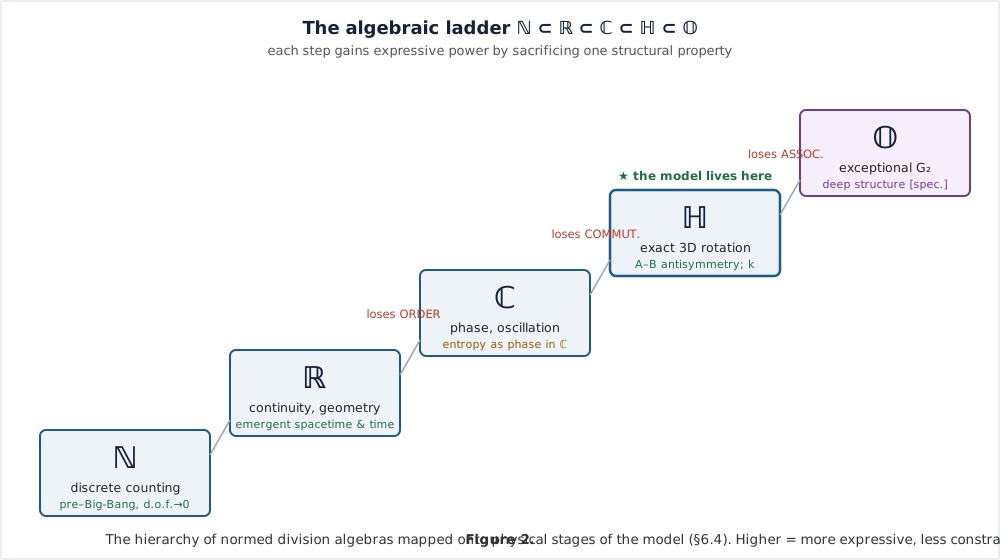
theorem (1898). Ascending the chain ℝ ⊂ ℂ ⊂ ℍ ⊂ 𝕆, each extension doubles
the dimension and surrenders a structural property: ℂ loses the natural ordering of ℝ; ℍ
loses commutativity; 𝕆 loses associativity. The quaternions encode three-dimensional rotations through
their non-commutative product (ij = k, ji = −k); the octonions are
the unique non-associative normed division algebra, and their automorphism group is the exceptional Lie
group G₂. These are standard mathematical facts; the framework’s novelty lies in the proposed
correspondence between this hierarchy and a cosmological structure, not in the mathematics itself.
4.3 Prior internal development
This manuscript is the consolidation of an evolving personal archive (informally versioned v1–v15,
October 2025 – May 2026; see §9.3). Earlier versions developed the coupled-universe dynamics,
entropy and arrow-of-time arguments, and a series of appendices; later versions introduced the algebraic
compression that is foregrounded here. The consolidated edition retains the surviving claims and discards
material identified by the author as method-mistaken-for-result or metaphor-mistaken-for-physics (see
§7.3).
5. Methodology
Because this is a conceptual and analytical work rather than an experimental one, the
“Methodology” describes the analytical and editorial procedures used to develop and
compress the framework. No physical experiment or numerical simulation is claimed.
5.1 The model construction
The physical model is specified by a small set of postulates (§6.1) from which the antisymmetric
dynamics and the Λ reinterpretation follow. The construction is deductive: given the postulates, the
behaviour of the coupled system and its algebraic signature are derived rather than fitted to data.
5.2 Recursive compression
The principal analytical method is recursive compression: the full archive (estimated at
~500,000 words across v1–v15 and supplementary material) was repeatedly distilled, each pass
discarding restatement and metaphor while retaining only claims that survived re-examination. The author
reports that the technical constraints of the AI systems used — finite context windows and the
absence of cross-session memory — forced this compression at each step, and argues that the
constraint was generative rather than obstructive (§9.5).
5.3 Palindromic / mirror iteration
A complementary procedure, described in the archive as the “palindromic mirror” method, ran
ideas forward and then in reverse (an expansion 1→2→3→4 followed by a contraction
4→3→2→1), using the reverse pass as a filter. The author is explicit that this is a
method, not a result, and the consolidated edition treats it accordingly.
5.4 Multi-system human–AI iteration
Development proceeded as a dialogue across three AI systems with distinct roles (ChatGPT as critical
editor and structural clarifier; Grok as high-entropy interlocutor and algebraic explorer; Claude as final
distiller and synthesizer), with the human author retaining all creative direction and all decisions about
what to keep or discard (§9). A notable feature of the process was the use of high-entropy,
compressed keyboard input during high-cognitive-load states, which the AI systems treated as signal to be
decoded into the nearest coherent intent — an interaction style the author documents as part of the
method.
6. The Model and Its Analyses
This section corresponds to what an empirical paper would call “Experiments.”
Here it sets out the model and the analytical derivations (the “bridges”) that were tested for
internal consistency. The outcomes of these analyses are reported in §7.
6.1 Basic postulates
Two mirror universes A and B exist and are globally symmetric.
Each universe is individually homogeneous and isotropic at large scales.
There is no local interaction or direct causal exchange between A and B.
The coupling is global, geometric, and effective — not a classical force.
The total system preserves global symmetry throughout its evolution.
6.2 Antisymmetric dynamics
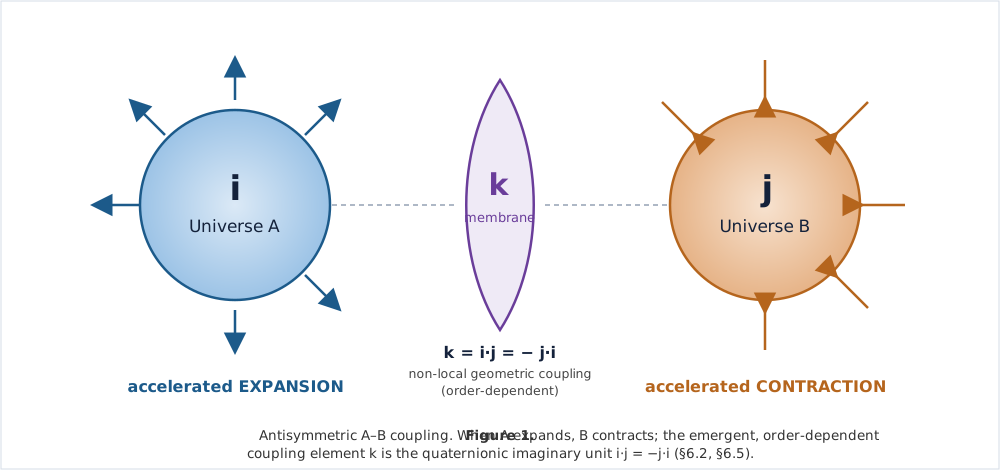
The A–B system evolves through antisymmetric alternation: when A undergoes accelerated expansion, B
undergoes accelerated contraction. This is presented not as a classical force but as an emergent geometric
response of the coupled system. The symbolic geometric identity is:
GA(a, ρ, P, keff) = GB(a, ρ, −P, keff)
The pressure inversion (P → −P) reflects the antisymmetric character. The Friedmann equation
(§4.1) is retained unchanged; Λ is reinterpreted as the effective parameter encoding the global
geometric coupling rather than an independent substance.
6.3 Entropy, phase conservation, and emergent time
Global entropy is taken to be conserved, SA + SB ≈ const. This is placed in
structural correspondence with norm conservation in ℂ: setting SA = cos²θ and
SB = sin²θ satisfies cos²θ + sin²θ = 1 identically, so the
cosmological cycle is parameterized as a phase rotation θ(t) in the complex plane. The Wick rotation
t → −iτ connects the temporal oscillation to a statistical (Euclidean)
distribution of entropy. Time is treated as emergent: it does not exist “before” the
Big Bang because the ℝ-continuum that makes “between two instants” meaningful does not yet
exist. The Big Bang is the ℕ→ℝ transition.
6.4 The algebraic map ℕ ⊂ ℝ ⊂ ℂ ⊂ ℍ ⊂ 𝕆
Each algebraic extension trades a structural property for expressive capacity; the framework maps this
hierarchy onto the physical structure of the model.
This bridge is developed in three layers (concrete to formal).
Layer 1 — definition. Non-commutativity means the order of combination changes the
result: a·b ≠ b·a. The model already asserts that applying A’s
dynamics then B’s yields a different global state than B then A.
Layer 2 — physical origin. In a commutative system the parts act independently. The
A–B coupling is global and antisymmetric: through the membrane, B’s response depends on the
state A has already produced, so sequence matters. This is the same reason spatial rotations do not commute
— each operation modifies the space in which the next one acts.
Layer 3 — correspondence. With i ↔ A, j ↔ B, the
membrane is the emergent element k: ij = +k (A then B), ji =
−k (B then A). The model’s own requirement kAeff ≈
−kBeff — equal magnitude, opposite sign, order-dependent result — is
precisely the algebraic definition of quaternionic non-commutativity. On this reading the global coupler
need not be postulated as a new mysterious entity: it is the third imaginary element k of the
quaternionic structure that A and B jointly form.
The conservation SA + SB ≈ const has the same structure as norm conservation
|eiθ|² = 1: two quantities oscillating in opposition while their quadratic
combination stays fixed. Under SA = cos²θ, SB = sin²θ, the
expansion–contraction cycle is a phase rotation in ℂ, and the Wick rotation t →
−iτ is the mechanism connecting the real-time oscillation to a Euclidean statistical
distribution.
Scope statement (preserved from the source). This bridge does
not assert that entropy “is” a complex phase. It is a structural
correspondence: the same algebraic skeleton appears in two places. It is therefore classified as
“moderate — include with caveats” (see §7.2), too precise to be mere metaphor, too
indirect to be literal physics.
6.7 Bridge analysis III: the deep projective structure and 𝕆
An earlier appendix posits that A and B are projections of a single deeper structure Ω. If
composing those projections is path-dependent — (Ω→A)→B ≠
Ω→(A·B) — the composition is non-associative, and by Hurwitz’s theorem the
only non-associative normed division algebra is 𝕆. The automorphism group G₂ = Aut(𝕆) then
becomes the candidate symmetry of the membrane.
Epistemic status: speculative. This is coherent and, if the projective
premise holds, structurally necessary — but it is not formally derived. Establishing it would
require showing that the symmetry-preserving transformations of the A–B coupling form precisely
G₂. This is flagged as an open problem (see §10), not a result.
7. Results
“Results” here means the outcomes of the consistency analyses and the
recursive compression — structural identifications and surviving claims — not empirical
measurements.
7.1 The irreducible core (recursive compression result)
After recursive compression across the full archive, five assertions survived. They are stated here with
their epistemic layer marked.
A well-formulated cosmological observation.[empirical-compatible] The accelerated expansion (Λ) could be
an emergent geometric effect of a global antisymmetric coupling with a complementary structure;
observationally indistinguishable from ΛCDM in the current regime; requires no exotic substance.
A solid algebraic correspondence.[rigorous] The
antisymmetric A–B dynamics have precisely the structure of quaternionic non-commutativity. The model
lives in ℍ; its foundations point to 𝕆. This is structural identification, not metaphor.
A principle about knowledge.[interpretive]
Mathematical systems are compressed languages that emerge when reality exhibits recurring structures at
multiple scales; each algebraic extension gains expressiveness by sacrificing a structural constraint.
An honest epistemic boundary.[methodological] The
model is a well-formulated question, not an answer; the boundary between rigorous, empirical, speculative,
and poetic must remain visible.
A note on process as result.[reflective] The work
was built collaboratively between a human and multiple AI systems over seven months; the process is part of
the result, not merely scaffolding.
7.2 Classification of the inter-version bridges
A two-pass iteration connecting the dynamical model (early versions) and the algebraic hierarchy (late
versions) identified five candidate bridges and classified them by strength:
C₀ = 1.69 as a mystical or universe-governing constant (retained only in the restricted
sense of §7.4).
The palindromic mirror “levels 1–15” treated as physical results (they are method).
Any claim about consciousness existing in imaginary time.
The “Cerberus” metaphor (fertile as narrative, not physics).
7.4 Reconciliation of the C₀ ≈ 1.69 claim
Flagged tension, resolved. The sources both discard C₀ =
1.69 (as a mystical constant) and retain it (as a dimensional marker). These are not contradictory:
the consolidated reading rejects any fundamental or governing role for C₀ and keeps it only as a
provisional marker of the ℕ→ℝ threshold (a Compton-scale indicator of the discrete-to-continuous
transition). Its epistemic status is speculative/moderate, pending a
derivation that does not yet exist.
7.5 The four-layer epistemic boundary
Layer
Representative content
Evaluation criterion
Rigorous
GA = GB with pressure inversion; Friedmann equations intact; ℍ captures A–B antisymmetry
Mathematical consistency
Empirical
Indistinguishable from ΛCDM; no new anisotropies; no modified local predictions
Observational agreement
Speculative
Entropy as phase in ℂ; C₀ as ℕ→ℝ marker; deep structure in 𝕆; G₂ as membrane symmetry
Coherence + fertility
Poetic
Observer as recursive fixed point; the model as a question; dedication
Habitability, not verification
The visible boundary is argued to be protective (a refutation in one layer does not contaminate
the others), inviting (each speculative claim is an explicit future-work item), and durable
(a later reader can tell exactly what was established, hypothesized, or metaphorical).
8. Discussion
The framework’s appeal is organizational rather than predictive. By leaving the Friedmann equations
intact and reinterpreting Λ as a coupling parameter, it offers a candidate account of the
dark-energy term without introducing new local physics. Its most defensible element is the algebraic
identification (§6.5, §7.1–2): the requirement of an equal-magnitude, opposite-sign,
order-dependent coupling is, by construction, quaternionic. This is a genuine structural correspondence and
the strongest claim in the manuscript.
The weaker claims are clearly labelled. The entropy–phase bridge (§6.6) is an elegant
structural analogy but not a physical identity; the octonionic deep structure (§6.7) is coherent but
underived. The author’s decision to present these with explicit epistemic tags, rather than to inflate
them, is consistent with good scientific hygiene and is itself part of the contribution.
On the methodological side, the manuscript is unusual in documenting its own production. The claim that
AI context-window limits and the absence of cross-session memory forced a productive compression
(§9.5) is a concrete, testable observation about human–AI workflows: constraints acted as a
selection pressure favouring the essential. Whether this generalizes beyond the present case is open, but
the case is reported with enough detail to be examined.
9. Limitations
No empirical test. The framework is, by the author’s own statement,
observationally indistinguishable from ΛCDM in the current regime. It therefore makes no new,
falsifiable prediction at present and cannot be empirically preferred.
The octonionic claim is underived. The G₂ = Aut(𝕆) membrane symmetry rests
on an unproven path-dependence premise (§6.7).
Structural vs. physical correspondence. Several mappings (entropy–phase;
C₀) are structural analogies, not demonstrated physical identities.
No formal bibliography. The source archive contains no external citations; standard
results (Friedmann equations, ΛCDM, Hurwitz’s theorem, G₂) are referenced generically
here and require proper citation before formal submission (see Unresolved Issues).
Single-author, non-peer-reviewed. This is a personal manuscript deposit; it has not
undergone external peer review.
Process documentation is self-reported. The collaborative-process findings (§9
of the model / the process appendix) are first-person and not independently verified.
10. Future Work
Derive (or refute) the octonionic symmetry. Show whether the symmetry-preserving
transformations of the A–B coupling form precisely G₂ — the content of a hypothetical
“v16.”
Seek a distinguishing prediction. Identify any regime (early universe, large-scale
anisotropy, parameter drift) in which the coupled-mirror picture would differ observationally from
ΛCDM.
Formalize the C₀ marker. Provide a principled derivation of the
ℕ→ℝ transition scale, or discard the marker.
Strengthen the entropy–phase bridge. Determine whether the ℂ phase
correspondence can be promoted from analogy to a derived relation.
Independent study of the process claims. Test whether constraint-driven compression in
human–AI workflows generalizes beyond this case.
11. Conclusion
This manuscript presents a speculative, internally consistent reframing of the cosmological constant as
an emergent geometric effect of a globally coupled mirror universe, together with a structural
identification of the model’s natural algebraic home in the quaternions and a speculative extension to
the octonions. Its strongest claim — that the required antisymmetric coupling is, by construction,
quaternionic non-commutativity — is offered as a genuine structural result; its weaker claims are
labelled as speculative and left as explicit open problems. Equally, the work documents a long human–AI
collaborative process and argues that the constraints of that process were generative. The manuscript does
not claim to answer a cosmological question; it claims to have formulated one carefully, and to have kept
visible, throughout, the line between what is established, what is hypothesized, and what is metaphor.
Dedication (poetic layer). This work began, in part, as a way of continuing
conversations that could no longer be had. The author’s father loved science fiction, astronomy, and
the great questions about the origin of the universe, and would let those questions float, unresolved,
comfortable in their enormity. This manuscript is dedicated to him, and to everyone who held out a hand at
the right moment — even briefly, even without knowing what they were anchoring.
12. References
Note. The source archive contains no formal bibliography. The items
below identify the standard results invoked and the internal artifacts consolidated. Proper, citable
references (with editions and page numbers) should be added before any formal submission.
Standard results referenced (to be cited formally):
The Friedmann–Lemaître equations of relativistic cosmology (standard general relativity).
The ΛCDM concordance model of cosmology (standard).
Hurwitz’s theorem on normed division algebras (A. Hurwitz, 1898): ℝ, ℂ, ℍ,
𝕆 are the only normed division algebras over the reals.
The exceptional Lie group G₂ as the automorphism group of the octonions, Aut(𝕆) (standard).
The Wick rotation t → −iτ relating Lorentzian and Euclidean
formulations (standard).
Internal artifacts consolidated in this edition:
Tarek, Speculative Model of Coupled Mirror Universes — core manuscript (Zenodo personal
deposit, May 2026).
Tarek, Appendix 23 and associated process transcripts — recursive-compression and
“codec” sessions with ChatGPT, Grok, and Claude (Nov 2025 – May 2026).
Internal version archive v1–v15 (Oct 2025 – May 2026), including bilingual PDFs, audio
recordings, infographics, and code-execution outputs (see chronology, §9.3 of the process appendix).
Consolidated edition v16 · prepared for Zenodo deposit · Tarek,
tarek.notebook@gmail.com · @echoeseveryname · Ejea de los Caballeros, Aragón, Spain ·
June 2026. This edition merges the core manuscript and the process appendix, removes redundancy, retains the
strongest explanation of each concept, and preserves the author’s four-layer epistemic boundary.